Research

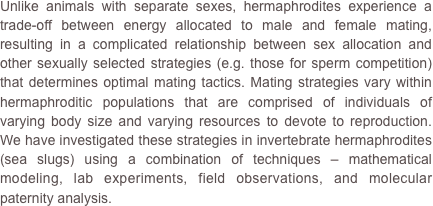
Reproductive strategies of simultaneous hermaphrodites
Our research involves experimental manipulations, behavioral observations, and mathematical and molecular tools to investigate the evolutionary basis for animal behavior.
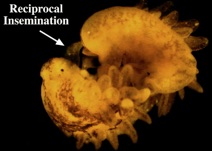
Male smallmouth bass defend nests in a closed seepage lake in northern Wisconsin, providing an ideal study system to investigate reproductive and life history strategies. This research is part of a long-term, collaborative study with Drs. Dan Wiegmann, Jeff Baylis, and Kelly Weinersmith to track reproductive patterns of every breeding male in the lake across years. A combination of field and mathematical tools allow us to address questions regarding diversity in the age of first reproduction, nest-site fidelity across years and behavioral patterns that change with breeding experience.
Life history strategies and nesting behavior of smallmouth bass
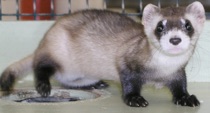
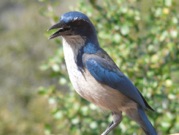
Over the past few decades there have been calls for greater efforts to apply principles of animal behavior to efforts in conservation biology. Through the research of graduate students in the lab, we are tackling behavioral questions with conservation applications. For example, we studied the behavior of endangered black-footed ferrets in captivity and the wild (with former M.S. student Sharon Poessel and former PhD student Travis Livieri), the reproductive ecology of the endemic Island Scrub-Jay (with former M.S. students Luke Caldwell and Michelle Desrosiers), and the effects of anthropogenic noise and light on wildlife behavior (see below). Work led by former postdoc Dr. Chris Schell in collaboration with Dr. Stewart Breck investigated the mechanisms explaining conflict-related behavior of coyotes in urban Denver.
The interface between animal behavior and conservation biology
Trinidadian guppy populations experience different levels of predation pressure in their natural habitats. We have investigated the plasticity and evolution of behavioral strategies when guppies are introduced from a high predation environment to a low predation environment. This NSF-funded project includes a combination of field work in Trinidad and laboratory experiments conducted by former Ph.D. student Dale Broder.
The role of plasticity in the evolution of behavior
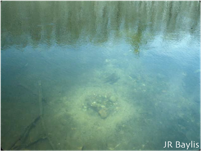
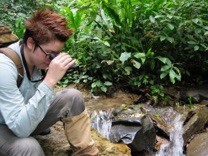
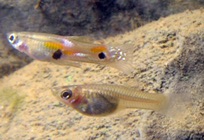
Gene flow may have negative effects on fitness by introducing maladaptive alleles and breaking down local adaptation, or it may have positive effects by adding genetic variation to inbred populations. We investigated the effects of gene flow from Trinidadian guppies adapted to a high predation environment into populations adapted to a low predation environment. This NSF-funded project involved a combination of field work, genetics and laboratory experiments in collaboration with Dr. Chris Funk, Dr. Sarah Fitzpatrick, and former MS student John Kronenberger.
The effects of gene flow on local adaptation
Paul Bentzen
Sharon Poessel
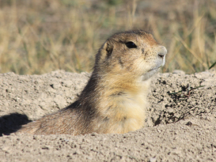
With funding from the National Park Service and collaboration with the NPS Natural Sounds and Night Skies Division and the labs of Drs. Kevin Crooks and George Wittemyer, we have formed the CSU Sound and Light Ecology Team. Our main goal is to investigate the effects of anthropogenic noise and light on wildlife behavior. We studied the effects of noise on elk, pronghorn, mule deer, and prairie dog behavior (with former M.S. students Casey Brown and Emma Brown and former postdoc Dr. Graeme Shannon). Work led by former postdoc Dr. Rachel Buxton investigated noise levels across US protected areas, and the research of former postdoc Dr. Brett Seymoure and research associate Jeremy White investigated the impacts of light pollution.
The effects of anthropogenic noise and light on wildlife behavior
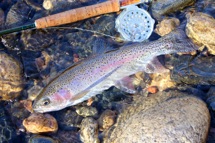
With Dr. Eric Fetherman and other colleagues at Colorado Parks & Wildlife we have investigated the role of the rearing environment in shaping the behavior and survival of hatchery reared fish, including economically important species (rainbow trout) and species of conservation concern (Arkansas darters). This work was led by former Ph.D. student Chris Kopack.
The use of environmental enrichment to enhance the behavior and survival of hatchery reared fish
Ari Koyama